How to Choose the Best Retirement Annuity
A complete guide to RAs in South Africa for 2025.
A Retirement Annuity (RA) is one of the best ways to save for retirement in South Africa - thanks to significant tax benefits. But with dozens of providers and thousands of fund options, choosing the right one can be overwhelming.
In this guide, we explain how RAs work, compare the top providers, and help you find the best retirement annuity for your situation.
Quick Summary
- Best Low-Cost: 10X Investments or Sygnia - fees under 1%
- Best for DIY: Easy Equities RA - choose your own ETFs
- Best Active Manager: Allan Gray or Coronation - proven track record
- Tax Benefit: Deduct up to 27.5% of taxable income (max R350,000/year)
What is a Retirement Annuity?
A Retirement Annuity is a tax-efficient savings vehicle designed for retirement. Unlike a pension fund (which is linked to your employer), an RA is personal - you own it, control it, and it moves with you when you change jobs.
Key Features:
- Tax deduction: Contributions reduce your taxable income (up to 27.5%)
- Tax-free growth: No tax on dividends, interest, or capital gains inside the RA
- Protected from creditors: Can't be seized if you go bankrupt
- Locked until 55: Cannot withdraw before age 55 (except emigration)
The Tax Benefits Explained
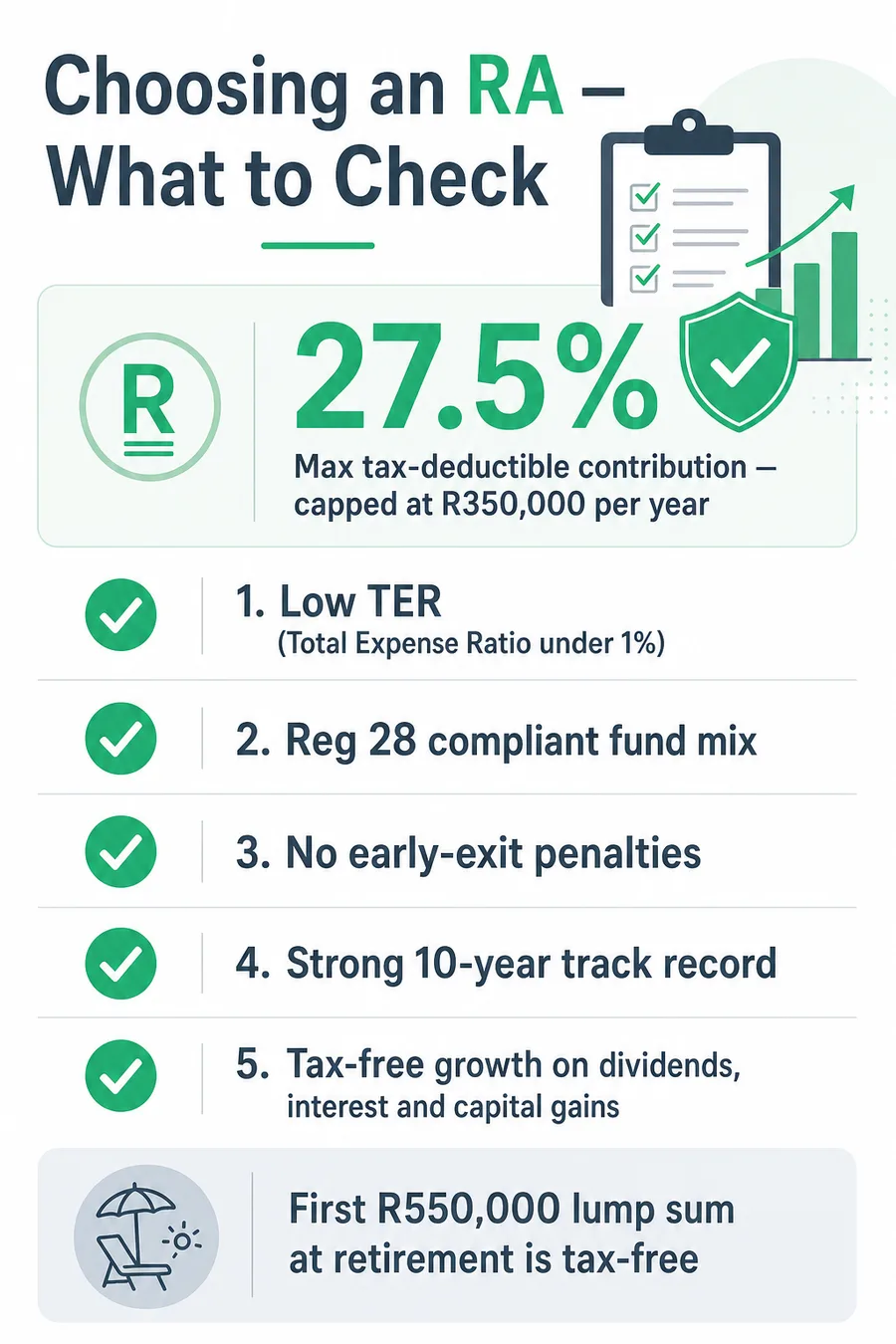
This is where RAs really shine. Your contributions reduce your taxable income:
Example: Earning R500,000/year
Contribution Limits
- • Max 27.5% of taxable income
- • Capped at R350,000 per year
- • Includes pension fund contributions
At Retirement
- • First R550,000 lump sum is tax-free
- • Rest must buy a pension (annuity)
- • Pension income is taxed as income
Best Retirement Annuity Providers (2025)
We've compared the top RA providers based on fees, investment options, and value:
| Provider | Total Fees | Rating |
|---|---|---|
10X Investments Low-cost passive investing | 0.7% - 1.0% | 4.7 |
Satrix Pure index investing | 0.4% - 0.8% | 4.6 |
Sygnia Cost-conscious investors | 0.6% - 1.1% | 4.5 |
Easy Equities RA DIY investors | 0.25% + 0.3% | 4.4 |
Allan Gray Active management believers | 1.0% - 2.0% | 4.3 |
Coronation Long-term active investing | 1.0% - 1.8% | 4.2 |
Discovery Discovery ecosystem users | 1.2% - 2.0% | 4 |
Old Mutual Full-service & advice | 1.5% - 2.5% | 3.8 |
* Fees include administration, platform, and average fund fees. Actual fees depend on funds chosen.
Our Top Picks
10X Investments
10X pioneered low-cost investing in SA. Their index-tracking approach keeps fees minimal while delivering market returns. Perfect for those who believe you can't consistently beat the market.
Allan Gray
South Africa's most respected active manager with a 50+ year track record. Higher fees, but their contrarian approach has delivered outperformance over the long term.
Easy Equities RA
Build your own retirement portfolio with individual ETFs and shares. Lowest trading fees, but requires more knowledge and hands-on management.
Why Fees Matter So Much
A 1% difference in fees might not sound like much, but over 30 years it's massive:
The difference between 0.5% and 2.5% fees = R2.4 million less in retirement. Always check the total effective annual cost (TEAC).
How to Choose the Right RA
1. Decide: Active vs Passive
Passive (index funds): Lower fees, matches market returns. Best for most people.
Active (fund managers): Higher fees, aims to beat the market. Requires faith in the manager.
2. Compare Total Fees
Look at the Total Expense Ratio (TER) or Total Investment Cost (TIC). This includes admin fees, platform fees, and fund fees. Aim for under 1% if possible.
3. Check Regulation 28 Compliance
All RAs must follow Regulation 28, which limits offshore exposure to 45% and equity to 75%. This protects your retirement savings from excessive risk.
4. Consider Your Time Horizon
20+ years to retirement: Can take more risk with higher equity exposure.
Under 10 years: Consider more conservative options with less volatility.
5. Do You Want Advice?
DIY: 10X, Sygnia, Easy Equities - lower fees, you decide.
With advice: Old Mutual, Discovery, financial advisors - higher fees, hand-holding.
Active vs Passive: Which is Better?
Passive / Index Funds
- Lower fees (0.3% - 0.8%)
- Matches market returns
- No manager risk
- Simple to understand
Providers: 10X, Sygnia, Satrix, Easy Equities
Active Management
- Potential to beat the market
- Professional management
- Higher fees (1.5% - 2.5%)
- Most underperform long-term
Providers: Allan Gray, Coronation, Ninety One
Our view: For most people, low-cost passive funds are the better choice. Studies show 80%+ of active managers underperform index funds over 15+ years, after fees.
Important Warnings
- • Your money is locked until 55. Don't contribute money you might need before then.
- • Early withdrawal is expensive. You can only access funds before 55 through formal emigration or in extreme cases.
- • At retirement, you can only take 1/3 as cash. The remaining 2/3 must buy an annuity (pension).
- • Beware of commission-hungry advisors. Some push high-fee products for their commission. Ask for fee disclosure.
- • Past performance doesn't guarantee future returns. A fund that beat the market last decade might not do so again.
Frequently Asked Questions
How much should I contribute to my RA?
Aim for 15% of your income towards retirement (including employer contributions). The tax benefit makes RAs very efficient up to the 27.5% limit.
Can I have multiple RAs?
Yes, you can have as many RAs as you want. However, the 27.5% tax deduction limit applies to your total contributions across all retirement funds.
Should I get an RA if I have a pension fund?
Yes, if you're not maxing out the 27.5% limit through your pension fund. An RA gives you control and portability that pension funds don't.
What happens to my RA if I die?
Your nominated beneficiaries receive the funds. Unlike other assets, RA proceeds go directly to beneficiaries and don't form part of your estate (no executor fees).
Can I transfer my RA to another provider?
Yes, you can transfer your RA tax-free between providers. The process takes 4-8 weeks. Check for any exit fees with your current provider.
RA vs TFSA - which is better?
Both are great. RA gives immediate tax relief but is locked until 55. TFSA has no tax relief on contributions but is fully accessible. Ideally, use both.
How to Open a Retirement Annuity
Choose Your Provider
Based on fees, investment approach, and your preferences. Low-cost index? Go 10X or Sygnia. Want Allan Gray's track record? Go with them.
Complete FICA Requirements
You'll need ID, proof of address, and bank details. Most providers allow online applications.
Select Your Fund(s)
Choose a single balanced fund, or build a portfolio. If unsure, a high-equity balanced fund is a solid default.
Set Up Debit Order
Automate your contributions. Starting with R500/month is fine - you can increase later. Consistency matters more than amount.
Our Recommendation
For most South Africans, we recommend a low-cost passive RA from 10X, Sygnia, or Satrix. The fee savings over 30 years can mean hundreds of thousands more in retirement.
Just starting out?
10X High Equity fund - simple, low cost, suitable for long horizons.
Want control?
Easy Equities RA - choose your own ETFs like Satrix Top 40 or MSCI World.
Believe in active?
Allan Gray Balanced - proven managers, but accept the higher fees.