AA Rate per KM Calculator: SARS 2026/27 Guide
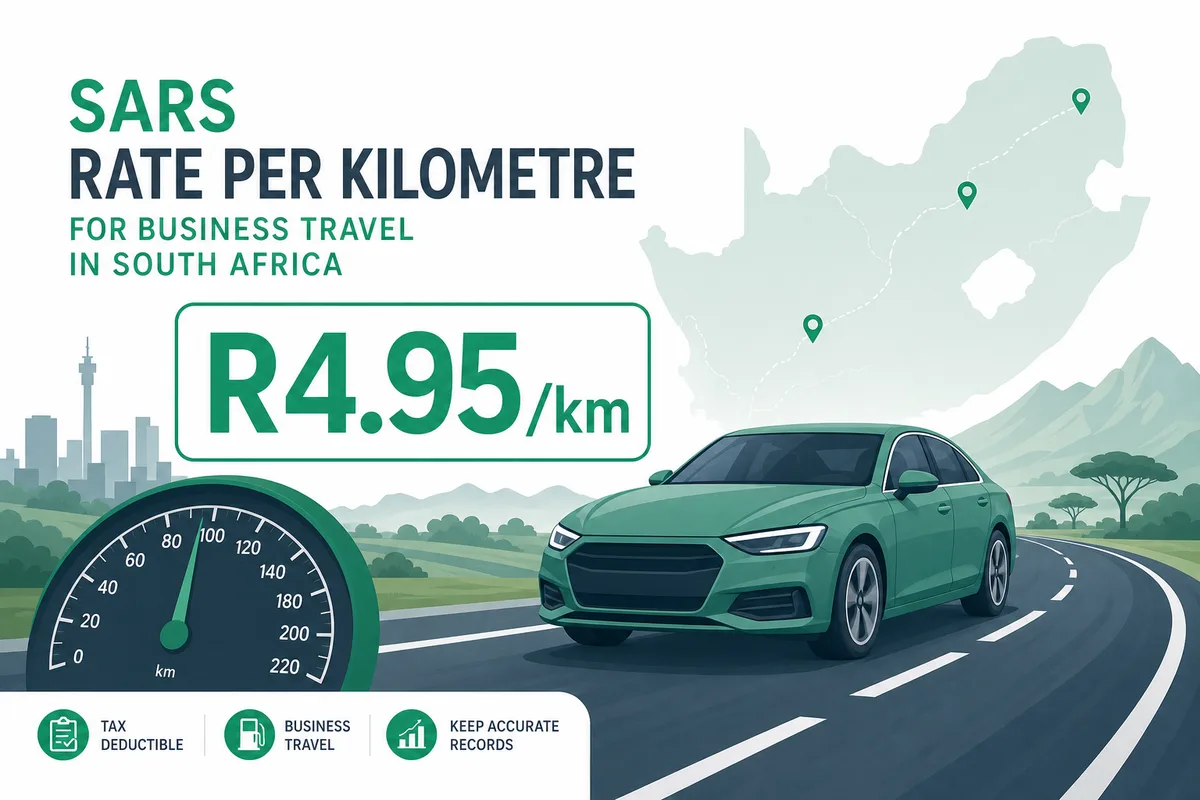
There is no single universal AA rate: the AA calculates a vehicle-specific figure. SARS's prescribed reimbursive rate is R4.95 per business kilometre from 1 March 2026. Use the calculator below to compare that benchmark with the gazetted SARS cost scale.
What is the AA rate per km in South Africa for 2026?
There is no one-size-fits-all AA rate: the AA's calculator issues a cost-per-kilometre figure for a specific vehicle. For tax, SARS prescribes R4.95 per recorded business kilometre from 1 March 2026. A qualifying reimbursement at or below that rate is not subject to PAYE, but SARS says a logbook is required to substantiate the business kilometres.
- SARS prescribed rate (2026/27)
- R4.95 / km
- Previous year (2025/26)
- R4.76 / km
- Effective from
- 1 March 2026
- Logbook required?
- Yes, for business km
SARS Rate per KM Calculator
SARS 2027 tax year · effective 1 March 2026
Usually the original cost including VAT, but excluding finance charges or interest. The gazetted cost scale is capped at R920,000.
Your vehicle's SARS band
- Fixed cost: R98,689 / year
- Fuel cost: 161.2c / km
- Maintenance cost: 67.8c / km
Fixed (R3.08) + Fuel (R1.61) + Maintenance (R0.68)
For 15,000 recorded business km
Cost-scale claim
R80 610
Simplified (R4.95/km)
R74 250
The cost-scale estimate is R6 360 higher. These methods have different eligibility rules; the larger number is not automatically tax-free or what an employer must pay.
Estimate assumes the vehicle was used for business for the full tax year; the fixed cost must otherwise be apportioned. A logbook is required to substantiate business kilometres. Source: SARS 2027 rate-per-kilometre rules. The AA's separate calculator produces vehicle-specific rates rather than one universal AA rate.
SARS rate per km 2026/27
SARS publishes a prescribed reimbursement rate and a vehicle-value cost scale for the 2027 tax year (1 March 2026 to 28 February 2027). They answer different tax questions:
Prescribed reimbursive rate
R4.95/km
A qualifying reimbursement at or below this rate is not subject to PAYE. Actual business kilometres must be substantiated.
Cost-scale rate
Variable
Used to calculate a possible deduction against a travel allowance or advance when actual costs are not claimed.
Government Notice 7182 makes the simplified method unavailable when the employer pays other vehicle compensation, apart from parking or toll fees. SARS's employer guide also explains how a reimbursive amount and a separate travel allowance are coded and combined on assessment.
SARS cost scale (2027 tax year)
The complete cost scale in Government Notice 7182, dated 27 February 2026 and effective 1 March 2026. The total rate per km is (fixed cost ÷ annual km) + fuel + maintenance.
| Vehicle value | Fixed (R/year) | Fuel (c/km) | Maint (c/km) |
|---|---|---|---|
| ≤ R115,000 | 38,344 | 132.9 | 49.1 |
| R115,001 – R230,000 | 68,487 | 148.4 | 61.4 |
| R230,001 – R345,000 | 98,689 | 161.2 | 67.8 |
| R345,001 – R460,000 | 125,393 | 173.4 | 74.0 |
| R460,001 – R575,000 | 152,097 | 185.5 | 86.9 |
| R575,001 – R690,000 | 180,078 | 212.8 | 102.0 |
| R690,001 – R805,000 | 208,106 | 216.5 | 114.5 |
| R805,001 – R920,000 | 237,679 | 220.1 | 126.9 |
| > R920,000 | 237,679 | 220.1 | 126.9 |
Fuel may be included only when the employee bore the full fuel cost; the same condition applies to maintenance. Source: Government Notice 7182 and the SARS 2026/27 eLogbook.
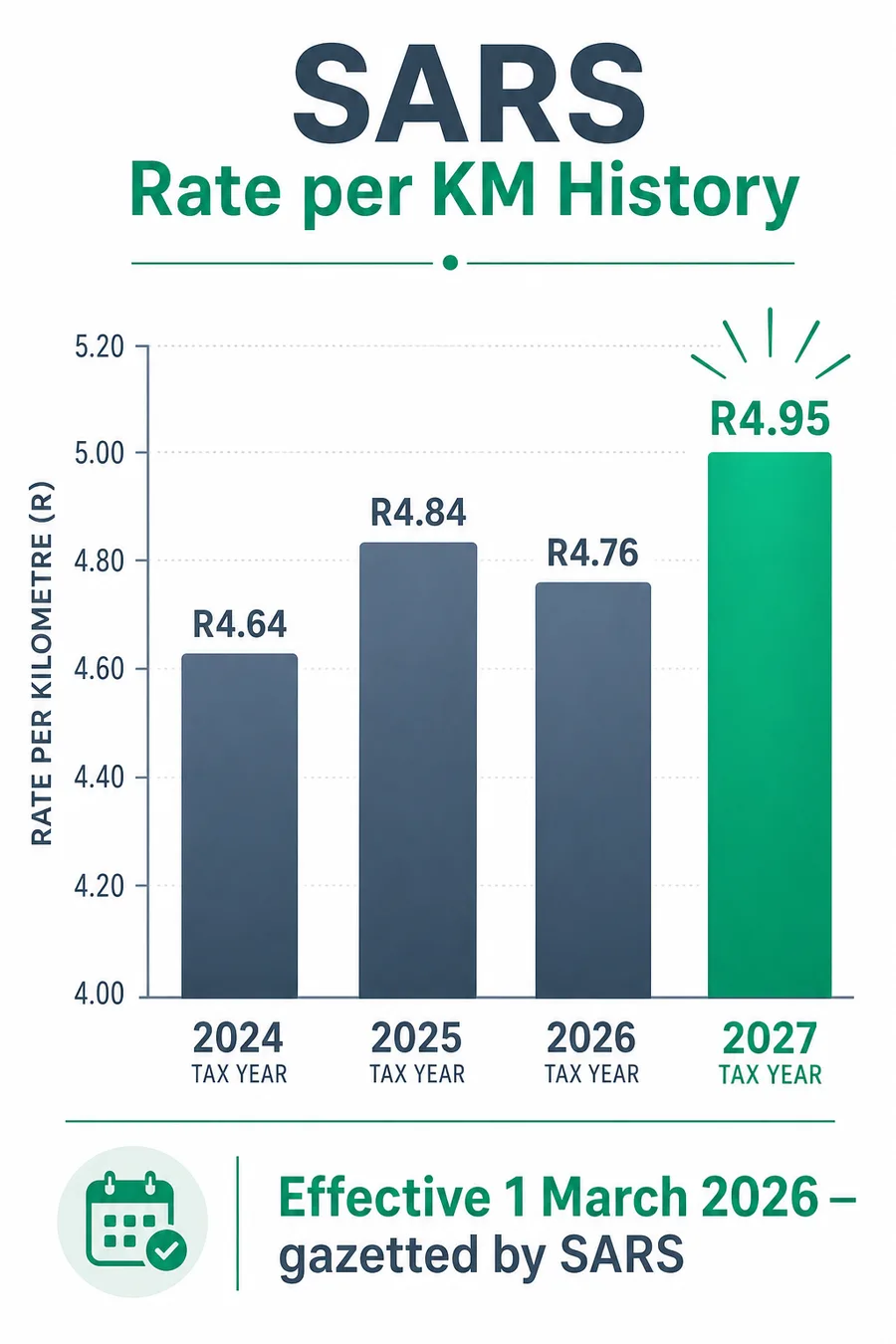
SARS rate history
- 2027 tax year (Mar 2026 – Feb 2027)R4.95/km
- 2026 tax year (Mar 2025 – Feb 2026)R4.76/km
- 2025 tax year (Mar 2024 – Feb 2025)R4.84/km
- 2024 tax year (Mar 2023 – Feb 2024)R4.64/km
The 2026/27 prescribed rate is about 4.0% higher than the previous year's R4.76.
AA tariewe per km 2026 - opsomming in Afrikaans
Die SAID-voorgeskrewe tarief vir die 2027-belastingjaar (1 Maart 2026 tot 28 Februarie 2027) is R4,95 per sakekilometer. 'n Kwalifiserende terugbetaling teen hoogstens dié koers is nie aan LBS onderhewig nie, maar 'n rylogboek is nodig om die werklike sakekilometers te staaf.
Daar is nie een universele AA-tarief nie. Die AA se aanlyn sakrekenaar gebruik voertuigspesifieke besonderhede om 'n koste-per-kilometer-sertifikaat te skep. Die SAID se R4,95-tarief en kosteskaal is belastingreëls; die AA-syfer is 'n afsonderlike kosteraamwerk.
Vinnige antwoorde
- Wat is die AA-tarief per km vir 2026? Daar is nie 'n enkele AA-koers nie; die SAID se voorgeskrewe koers is R4,95/km vanaf 1 Maart 2026.
- Het ek 'n rylogboek nodig? Ja. Hou 'n rylogboek om jou werklike sakekilometers te staaf.
- Kan ek my rit werk toe eis? Nee. SAID beskou huis-tot-werk-reise as privaat. Slegs sake-kilometers tel.
- Diesel of petrol? Die SAID-tabel gee nie afsonderlike petrol- en dieselkoerse nie.
Vir die volledige koersskaal, gebandeer volgens voertuigwaarde, sien die tabel hierbo. Bronne: SAID PAYE-GEN-01-G03-A01 (2027-belastingjaar).
Subsistence allowances 2026/27
For qualifying travel, SARS's deemed domestic subsistence amounts effective 1 March 2026 are:
Meals + incidental (local)
R595/day
For overnight business travel in South Africa.
Incidental only (local)
R184/day
Where meals are also reimbursed at actual cost.
Foreign-travel subsistence rates are published per country in the SARS PAYE-GEN-01-G03-A02 annexure. Looking for other tax-deductible items? See our guides on choosing a retirement annuity and tax-free savings accounts (TFSA).
AA rate vs SARS rate - the difference
AA rate
Industry estimate
The Automobile Association's logged-in Vehicle Rates Calculator uses vehicle-specific inputs to generate a cost-per-kilometre certificate.
Use it for vehicle-cost planning or an employer's travel-claim process where that policy accepts the AA certificate.
SARS rate
Tax rule
SARS publishes a cost scale banded by vehicle value and a prescribed reimbursive rate of R4.95/km for 2026/27.
Use the SARS rules to determine PAYE treatment and a possible deduction against a travel allowance. They do not set the rate an employer must pay.
Worked examples (2026/27)
These examples assume the employee owned the vehicle, used it for business for the full year and bore the full fuel and maintenance costs. They compare the arithmetic only; the two methods have different eligibility rules.
Example 1: Real-estate agent
An agent drives a Hyundai i20 (R280,000). 38,000 km/year, 22,000 km business. SARS cost-scale rate ≈ R4.89/km; the cost-scale amount for 22,000 business km is about R107,516. The prescribed-rate calculation is R108,900. The R4.95 figure is slightly higher here, but a logbook is still required to substantiate the business distance. If the vehicle was bought on finance, note that SARS vehicle value excludes finance charges and interest; see how car finance works.
Example 2: Field-services engineer
A Hilux 2.8 diesel (R620,000). 55,000 km/year, 40,000 km business. SARS cost-scale rate ≈ R6.42/km; the cost-scale amount is about R256,886. The R4.95 calculation is R198,000, a difference of about R58,886. That larger cost-scale amount is not automatically deductible: the engineer must receive a qualifying allowance or advance and meet the logbook and cost conditions.
Example 3: Hybrid-work consultant
A Golf (R420,000). 18,000 km/year, only 6,000 km business. SARS cost scale ≈ R9.44/km because fixed costs are spread over low total mileage; the cost-scale amount is about R56,642. The R4.95 calculation is R29,700. This illustrates why total annual distance changes the cost-scale figure; it does not let the employee choose the larger reimbursement without satisfying the relevant SARS rules.
What a SARS logbook must contain
Record the vehicle's odometer reading on 1 March and again at the end of the tax year. For each business trip, keep the date, distance, starting point, destination and business reason. SARS says you do not need to itemise private trips; its template marks opening and closing odometer fields for individual trips as optional.
| Date | Open km* | Close km* | Distance | From / to | Reason |
|---|---|---|---|---|---|
| 06/05/26 | 85,230 | 85,288 | 58 km | Office → Sandton | Client meeting – ABC Ltd |
| 06/05/26 | 85,288 | 85,322 | 34 km | Sandton → Midrand | Site inspection |
*Optional for each trip in the SARS template; the opening and closing readings for the tax year itself are essential. Retain the logbook for at least five years. Download the official eLogbook from SARS. If your driver's licence is due for renewal, see our driver's licence renewal guide.
Frequently asked questions
What is the SARS rate per km for 2026 in South Africa? +
What is the difference between the AA rate and the SARS rate? +
Can I claim AA or SARS rates for my commute to work? +
Do I need a logbook to claim the SARS rate? +
How is the SARS cost scale calculated? +
Does my employer have to pay R4.95 per kilometre? +
What are the SARS subsistence allowances for 2026/27? +
Does the SARS cost table have different petrol and diesel rates? +
Sources
- · Government Notice 7182 - the statutory 2027 vehicle cost scale and R4.95 simplified method.
- · SARS rates per kilometre - eligibility, fuel and maintenance conditions, and PAYE treatment.
- · SARS 2026/27 eLogbook - records required for a travel deduction.
- · SARS Budget 2026 FAQs - R4.95 reimbursement and 2026/27 subsistence amounts.
- · AA Vehicle Rates Calculator - vehicle-specific rate certificates (free AA Access login required).
MoneyToday is an editorial publication. Figures on this page are taken from the published SARS Government Gazette notice and are not personal tax advice. For a binding tax position consult SARS or a registered tax practitioner.
Related guides
Vehicle
How car finance works in SA
Interest rates, balloons, and total cost - what you actually pay over the term.
Loans
Compare personal & vehicle loans
Financing the car you're claiming for? Compare Capitec, African Bank, FNB and more side-by-side.
Loans
PEP (Capfin) loans: the real cost
Need cash for fuel or repairs before payday? The full cost of a Capfin loan, fees included.
Vehicle
Best car trackers in SA
Tracker comparison - insurance discounts and recovery rates.
Tax
Choosing a retirement annuity
Another tax-deductible expense for the same return - what to look for.
More tools
All free calculators
Loan, savings and vehicle calculators in one place.